
Company Registration in Australia in 7 Easy Steps
Complete guide covering requirements, process, costs, taxes, and business structures — with key considerations for overseas founders.
Why Open a Company in Australia?
Australia remains one of the most trusted and transparent jurisdictions for global business owners. Till June 2025, there were 2,729,648 actively trading businesses in the Australian economy. With a competitive corporate tax framework and strong banking credibility, Australia continues to attract entrepreneurs seeking a stable, English-speaking, and internationally recognised business base.
Credible Jurisdiction & Legal Protection
Australia’s regulatory environment offers limited liability under the Corporations Act 2001, with strong banking and accounting oversight — reducing risk and enhancing corporate trust.
Competitive Corporate Tax Environment
- 25% corporate tax rate for SMEs
- 30% standard rate for larger enterprises
- R&D tax incentives
- Startup and innovation concessions
International Market Access
Positioned as a key hub for Asia-Pacific trade with proximity to Singapore, Japan, India, and China — and strong bilateral agreements with the US, EU, and UK.
Access to Skilled Talent & High Quality of Life
A highly educated workforce in engineering, fintech, professional services, and digital technology — with strong living standards and immigration pathways for global teams.
Eligibility Requirements for Company Formation in Australia
To register a company in Australia as a foreign entrepreneur, you must meet the following criteria:
| Requirement for Australian Company | Status |
|---|---|
| Minimum Shareholder | 1 |
| Minimum Directors | 1 |
| Local Resident Director | Required |
| Local Company Secretary | Recommended |
| Registered Office Address | Required |
| Minimum Share Capital | No minimum |
| Business Name | Must be unique |
| ASIC Registration | Mandatory |
How to Open a Company in Australia?
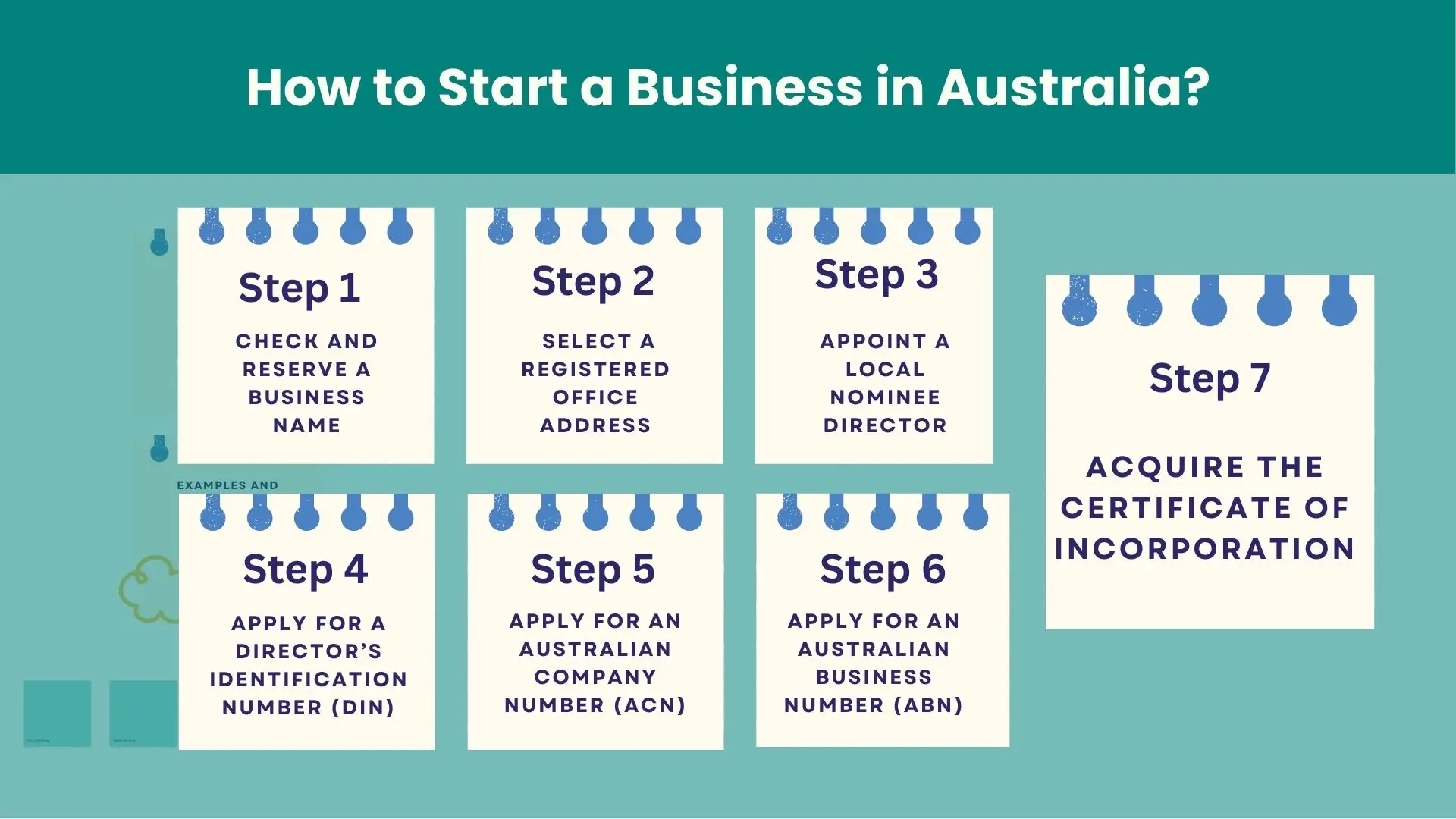
The process to open a company in Australia is outlined below. With OnDemand International, you can complete this within 2 weeks.
Check and Reserve a Business Name
The first step for new company registration in Australia is to select a unique name for your business. Then you must conduct a name search to guarantee it is accessible and no one else uses it. Our business experts can assist you with this phase.
Select a Registered Office Address
Every Australian company is required to have a registered office address. It could be a physical office or a virtual office, but it must be within Australia. This is where all legal documents, notices, and government communications will be delivered.
Appoint a Local Nominee Director
If you’re a foreign business owner, Australian law requires you to appoint at least one local Australian director. If needed, OnDemand International can provide a nominee director in Australia as part of our company formation service.
Apply for a Director’s Identification Number (DIN)
The Australian government requires all company directors to acquire a Director’s Identification Number (DIN). This helps identify directors and ensures transparency. Applications are submitted via the Australian Business Register.
Apply for an Australian Company Number (ACN)
The ACN is a unique nine-digit identifier required to register your company with the Australian Securities and Investments Commission (ASIC). It’s an essential step in legally forming your company.
Apply for an Australian Business Number (ABN)
The Australian Business Number is required for tax identification, issuing invoices, and dealing with the Australian Taxation Office (ATO). Our team guides you through the entire ABN application process.
Acquire the Certificate of Incorporation
Once everything is in place, you’ll receive a Certificate of Incorporation from ASIC. This official documentation confirms that your firm is legally registered and ready to operate in Australia.
Documents Required to Register a Company in Australia
The following documents are required for company formation in Australia:
- Complete Application Form
- ACN (Australian Company Number)
- Constitution or replaceable rules
- Notarized passport copies (shareholders & directors)
- Registered office address
- Shareholder details
- State/territory-specific documentation (if applicable)
Types of Business Structures for Australia Company Formation
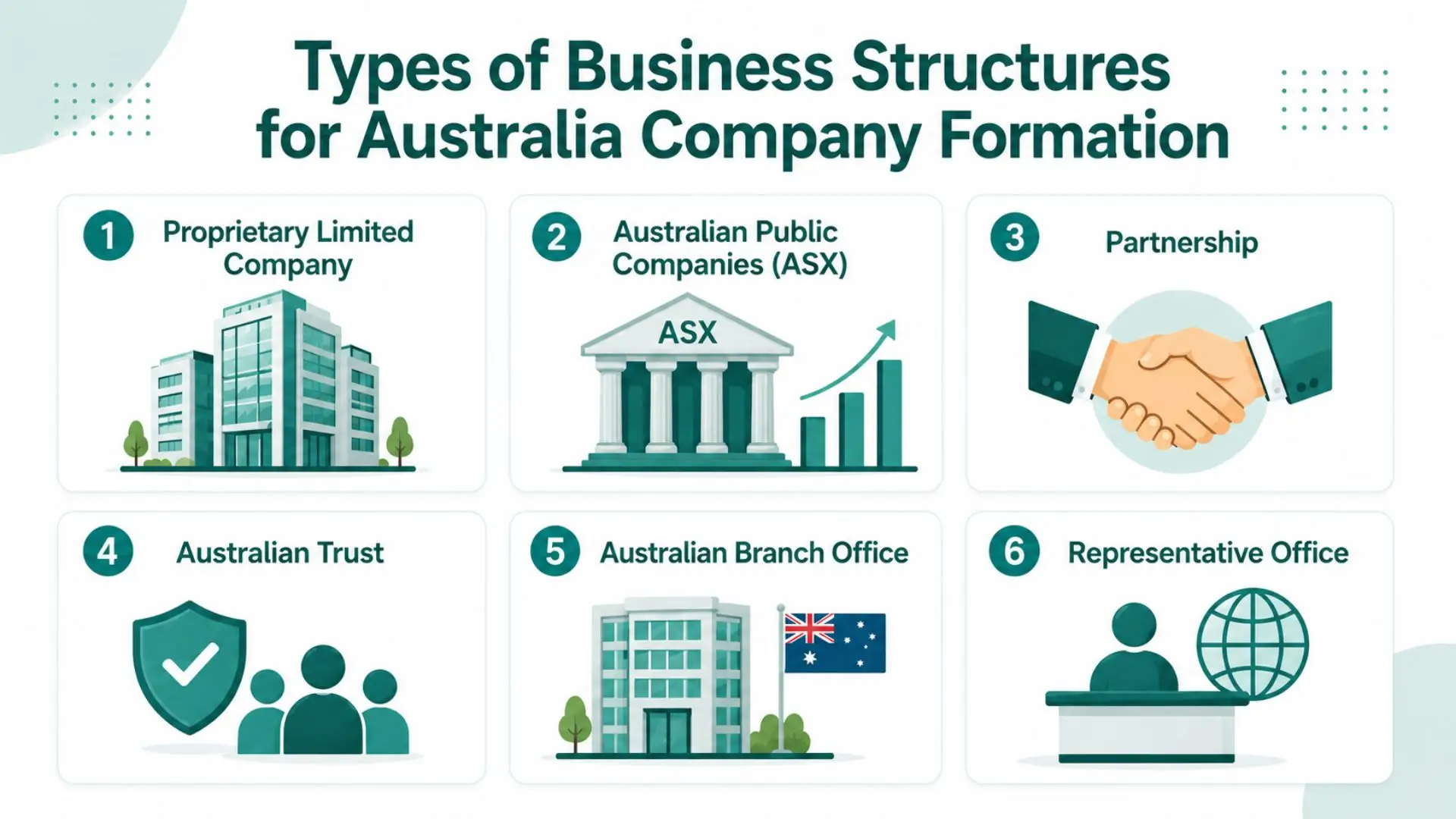
The various types of structures that can be established in Australia are:
Proprietary Limited Company (Pty Ltd)
The most popular corporate structure in Australia, nearest to an LLC. Can be 100% foreign-owned with share capital as low as $1. Requires at least one Australian resident director.
Australian Public Companies (ASX)
For businesses seeking to raise capital from a broader investor base. Requires at least 3 directors (2 Australian residents), a Company Secretary, and a Public Officer.
Partnership
Commonly used for accounting and legal services. Requires at least 1 Australian resident partner. Partners declare their portion of profits individually — no entity-level tax.
Australian Trust
Popular for family-owned businesses. Uses discretionary or unit trusts. Trusts don’t pay tax provided all earnings are distributed to beneficiaries. Created by deed — no ASIC registration required.
Australian Branch Office
Foreign companies can register a branch through ASIC and the ATO. Requires a local agent and registered address. Taxed on Australian earnings; annual ASIC financial reporting required.
Representative Office
Permits only non-commercial and limited activities. Ideal for market research before full entry. Simple to establish, though a branch or Pty Ltd is more cost-efficient long term.
Various Taxes for Company Registration in Australia
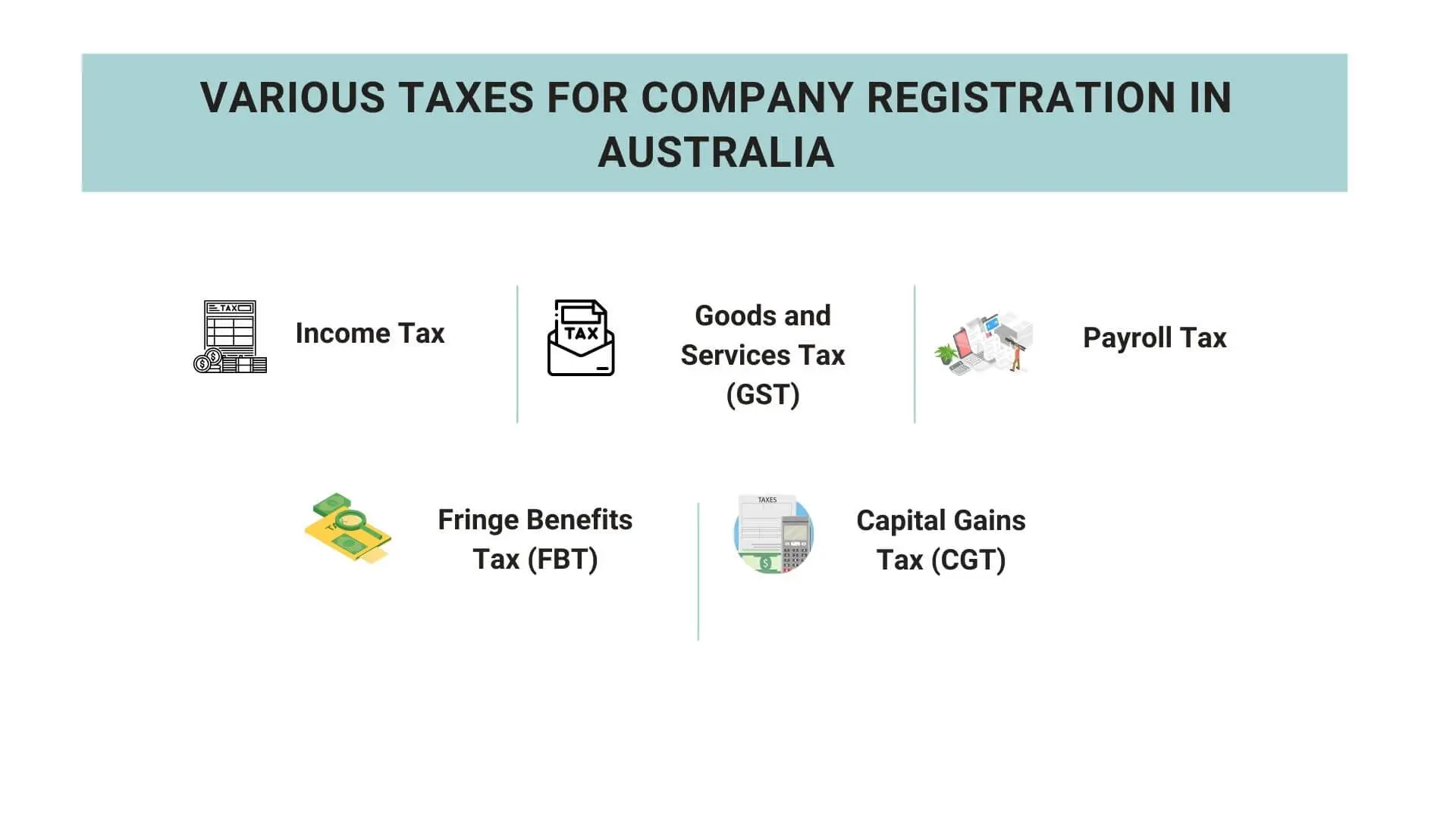
When registering a company in Australia, the following taxes may apply:
Income Tax
All Australian companies pay income tax at the corporate tax rate — 30% standard, or 25% for small and medium businesses.
Goods and Services Tax (GST)
Mandatory for companies with annual turnover above AUD 75,000. Federal rate of 10%; proceeds distributed to state governments.
Payroll Tax
Applies to companies whose payroll exceeds a state-specific threshold. Rates and thresholds vary by territory.
Fringe Benefits Tax (FBT)
Payable by employers on non-cash benefits provided to employees, such as company cars or low-interest loans.
Capital Gains Tax (CGT)
Applies to capital gains made from the sale of assets. Specific obligations vary by entity type and holding period. Consulting a tax professional is recommended to understand your company’s CGT position.
Cost to Open a Company in Australia
The cost to register a company in Australia can vary depending on the kind of firm and the services used to register it. The Australian Securities and Investments Commission (ASIC) charges a fee for registering a company.
Along with that, there are numerous other expenses to account for: legal fees for drafting the constitution, company name search fees, fees for acquiring the ABN and ACN, virtual office space, nominee director services, and other compliance costs.
Advantages of Registering a Company in Australia
Robust Legal Protection
Australian company law provides strong shareholder protection, limited liability, and a transparent regulatory framework, reducing operational and legal risk for business owners.
100% Foreign Ownership (Pty Ltd Structure)
Foreign entrepreneurs can fully own an Australian Proprietary Limited company without local shareholding requirements, making it ideal for international expansion.
High Global Credibility and Business Trust
An Australian-registered company is widely recognised by banks, investors, and global partners, enhancing commercial credibility and easing cross-border transactions.
Flexible Business Structuring Options
Australia offers multiple entity structures, allowing businesses to choose setups that align with tax efficiency, ownership strategy, and long-term growth plans.
Simple Ownership Transfer and Exit Options
Share transfers and ownership changes are legally streamlined, enabling efficient exits, restructuring, or onboarding of new investors.
Favourable Tax Concessions for SMEs
Eligible businesses benefit from reduced corporate tax rates, R&D incentives, and various concessions designed to support growth and innovation.
Conclusion
Australia stands out as a reliable and globally respected jurisdiction for foreign entrepreneurs seeking company formation. With its transparent legal framework, competitive tax environment, strong banking credibility, and strategic access to Asia-Pacific markets, Australia provides the stability and trust required to build and scale an international business with confidence.
Whether you need support with company formation in Australia, nominee director arrangements, tax and compliance structuring, or banking setup, at OnDemand International, we offer end-to-end guidance to ensure your business is established correctly, compliantly, and without unnecessary delays. Get in touch with us today.